

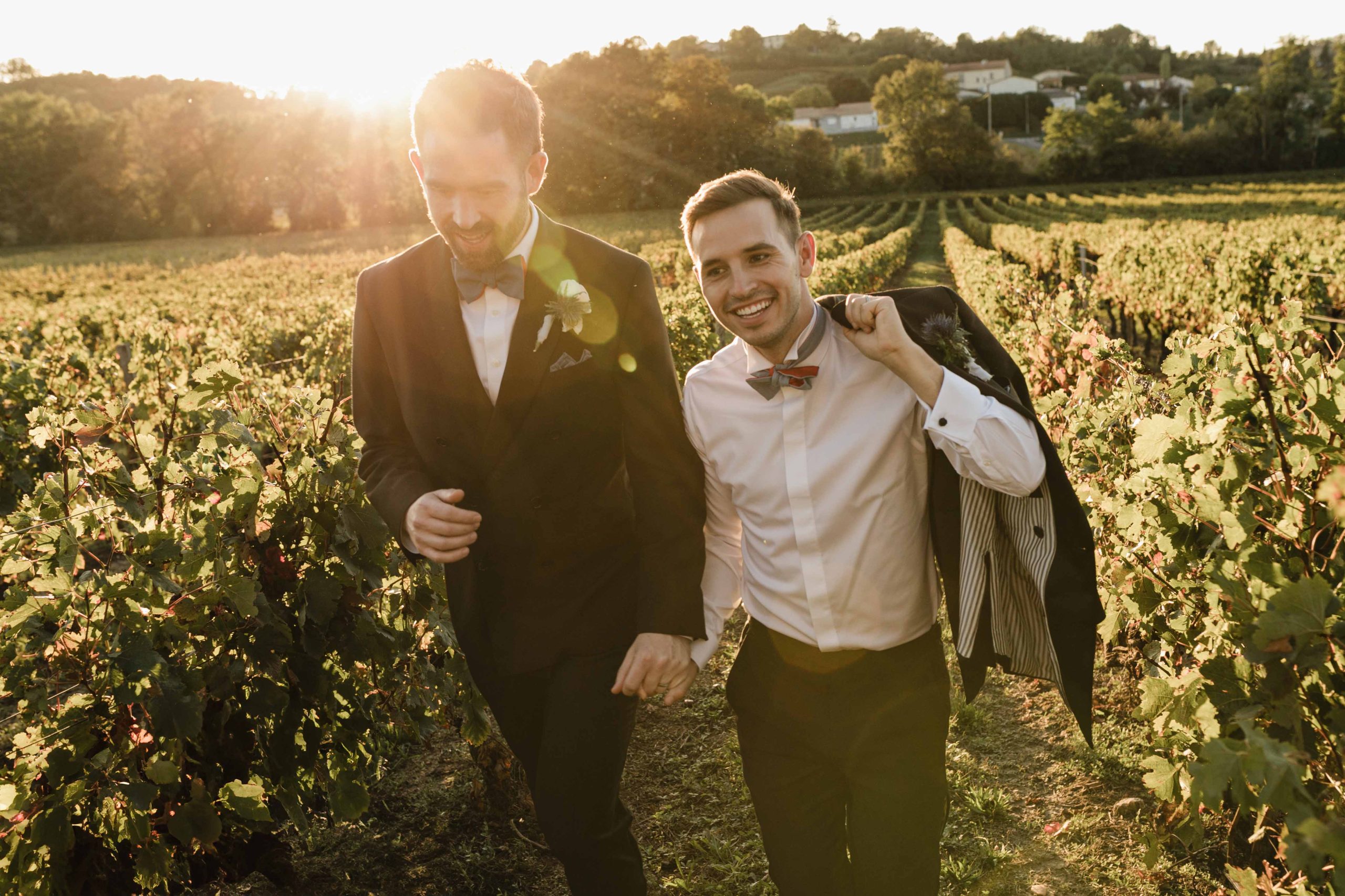
Choosing a queer wedding photographer in France is not only about finding someone who takes beautiful photographs. It is about choosing the person who will be beside you during some of the most intimate, emotional and occasionally chaotic hours of your wedding day.
You need someone who can make beautiful images, yes. You also need someone who will use the right names and pronouns, understand that chosen family is family, and avoid assigning one of you the role of “the man.” The bar should not be underground, and yet here we are.
As a queer and non-binary wedding photographer based in Paris, I know what it feels like to wonder whether a space is genuinely safe or merely decorated with a rainbow in June. I photograph LGBTQ+ and multicultural couples in France and across Europe with a documentary and editorial approach: attentive to the real relationships, atmosphere and identities that make each celebration yours.
This guide explains what genuine inclusion looks like in practice, which questions to ask before booking, and how to recognise a photographer who will see you without turning your wedding into a statement you never asked to make.
The short answer: how do you choose a queer-friendly wedding photographer?
Look for more than an “LGBTQ+ friendly” badge. A genuinely inclusive photographer should:
- use respectful, non-gendered language from the first conversation;
- ask for your names, pronouns and the words you use for one another;
- show queer people as people, not as a once-a-year marketing category;
- guide portraits without assigning masculine and feminine roles;
- understand that family structures and levels of support can be complex;
- respect your privacy and ask how your images may be shared;
- have a clear process for learning what — and who — matters to you.
You do not need a photographer who knows every flag by heart. You do need one who listens, adapts, owns a mistake if they make one and never expects you to provide Queer 101 between the ceremony and the champagne.
Why the photographer you choose matters
Your photographer will be there while you get ready, when nerves arrive, when a parent sees you for the first time and when your friends become emotionally ungovernable on the dance floor.
They will hear the language people use for you. They will photograph partners, parents, friends, ex-traditions, new rituals and the chosen family who helped you become yourselves. They will also make dozens of small decisions about whose reactions to notice, which relationships to include and how to guide you when a portrait needs a little direction.
Photography is not a neutral gaze. The person behind the camera shapes how your story is held.
For queer, trans and non-binary people, feeling observed does not always feel harmless. A good photographer understands that trust comes before access. You should not spend your wedding correcting assumptions or wondering whether tenderness will be treated as unusual. You should be able to breathe, move and be fully present with the person you are marrying.
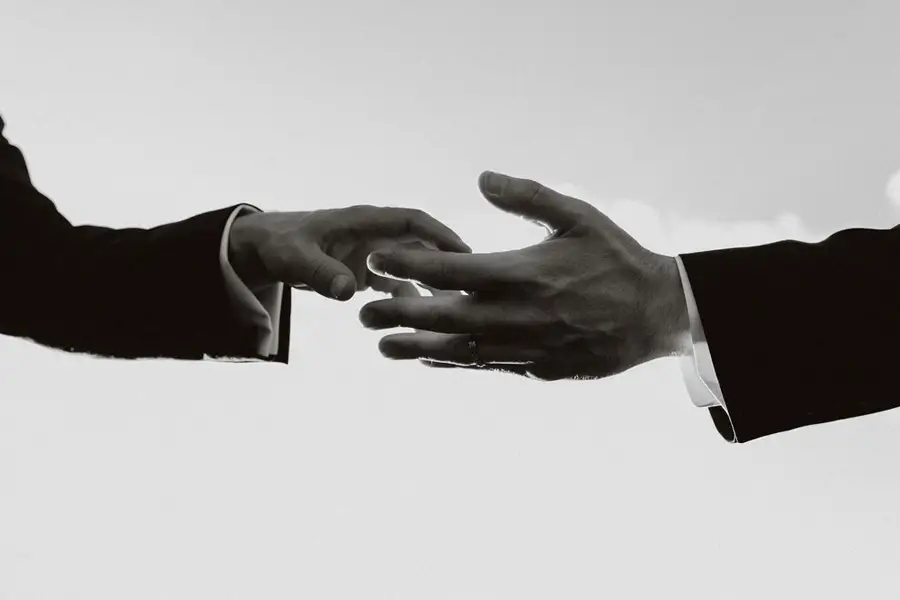
“LGBTQ+ friendly” is a starting point, not proof
Many wedding suppliers now describe themselves as inclusive. That is preferable to the alternative, obviously, but the words alone do not tell you much.
Genuine inclusion appears in a photographer’s whole way of working:
- Do their contact forms allow for different identities and relationship structures?
- Do they ask rather than assume how you want to be addressed?
- Can they talk about queer couples without making the conversation awkward or congratulating themselves?
- Do they understand that two women do not automatically want matching soft, feminine poses?
- Can they photograph two men without directing one to “be the bride”? Please, let that sentence retire.
- Do they treat non-binary and trans guests with the same care as the couple?
- Do they ask for consent before using sensitive images online?
A safe photographer does not make your queerness invisible, but they do not make it the only interesting thing about you either. Your relationship may also be funny, reserved, glamorous, tender, chaotic, multilingual, fashion-obsessed or deeply committed to leaving the party before midnight. You contain multitudes.
What to look for before you book
1. Their language feels natural, not performative
Read the website, inquiry form, emails and social media captions. Language is often the first clue to how a photographer thinks.
If every page assumes a bride and groom, or every pose is described through rigid gender roles, that does not necessarily make the photographer hostile. It does suggest that you may have to do more explaining than you want.
Inclusive language should feel easy rather than self-congratulatory. Nobody deserves a medal for writing “partner.” What matters is the attention behind it.
Look for a photographer who is curious without being intrusive, who can take correction without becoming defensive and who asks only for information that will help them care for you properly.
2. Their portfolio shows relationships, not tokens
Seeing queer couples in a portfolio can be reassuring. Look beyond their presence and pay attention to the way they are photographed.
Do the images feel emotionally specific, or could any couple have been dropped into the same poses? Are there different bodies, presentations, cultures and kinds of affection? Are chosen family and community visible? Do the photographs show an entire emotional range rather than one rainbow-adjacent portrait?
Ask to view a complete wedding gallery if possible. Instagram shows the greatest hits; a full gallery reveals how a photographer handles quieter moments, difficult light, family groups, speeches and the beautiful mayhem between the obvious highlights.
You can view my wedding photography gallery to see how I balance portraits, atmosphere and unscripted moments.
3. Their direction is not built around gender roles
There is nothing wrong with tradition when you have chosen it. The problem begins when tradition is assigned to you.
A photographer should not assume who will wear a suit or a dress; who proposes, leads or becomes emotional; who should hold or be held; or which partner should appear more masculine or feminine.
Good direction begins with your natural dynamic. Rather than casting you in borrowed roles, I use movement, proximity, conversation and simple actions. The aim is not to manufacture intimacy. It is to give the intimacy already there enough room to appear.
4. They understand that family can be complicated
Some queer couples are surrounded by wholehearted support. Others are navigating selective invitations, estrangement, misgendering, cultural expectations or relatives who are still “trying,” with varying levels of actual trying.
A photographer does not need every detail of your history. They do need enough information to avoid putting you in a painful situation: calling someone by the wrong name, forcing a family grouping, searching for a parent who is not invited or repeatedly asking who will perform a traditional role.
Before the wedding, tell them which relationships require care, who your essential people are and whether there are photographs you do or do not want. A thoughtful photographer will treat that information discreetly rather than turning it into wedding-day drama.
5. They have a real approach to privacy and consent
Not every couple can or wants to be visible online. Some people are not out everywhere. Others have sensitive jobs, complex families or simply prefer to keep their wedding private. None of these choices makes your celebration less proud or less queer.
Ask what the contract says about publication and whether you can restrict the use of particular photographs. The answer should be clear before you sign, not discovered when your first kiss becomes a Reel.
Privacy is not a lack of pride. It is a boundary, and boundaries can look fabulous.

Questions to ask before booking
You do not need to conduct an interrogation under a single swinging lightbulb. A short conversation should tell you a lot.
“How do you make your process inclusive?”
A useful answer will include specific practices, not only values: the questions they ask, the language they use, how they prepare for family photographs and how they respond when a couple has particular privacy or safety needs.
“How do you guide people who feel awkward on camera?”
Most people are not professional models. Frankly, most professional models are not being photographed while their aunt looks for a missing buttonhole.
The photographer should explain how they help without pushing you into poses that feel unnatural. Ask whether their direction changes according to the couple rather than relying on fixed “bride” and “groom” prompts.
“Can we share our pronouns, family language and sensitive dynamics?”
The answer should be an uncomplicated yes. A good process gives you a private way to share what the photographer genuinely needs to know, without making you repeat it to every member of the team.
“May we see a complete gallery?”
A complete gallery helps you assess consistency and care. Notice whether guests are photographed thoughtfully, whether emotional moments have context and whether the couple still looks like themselves throughout the day.
“How will you use our photographs?”
Ask what is covered by the contract, whether you can request partial or complete confidentiality and how second photographers or other suppliers are briefed. This question matters for every couple and can be particularly important for people who are not publicly out.
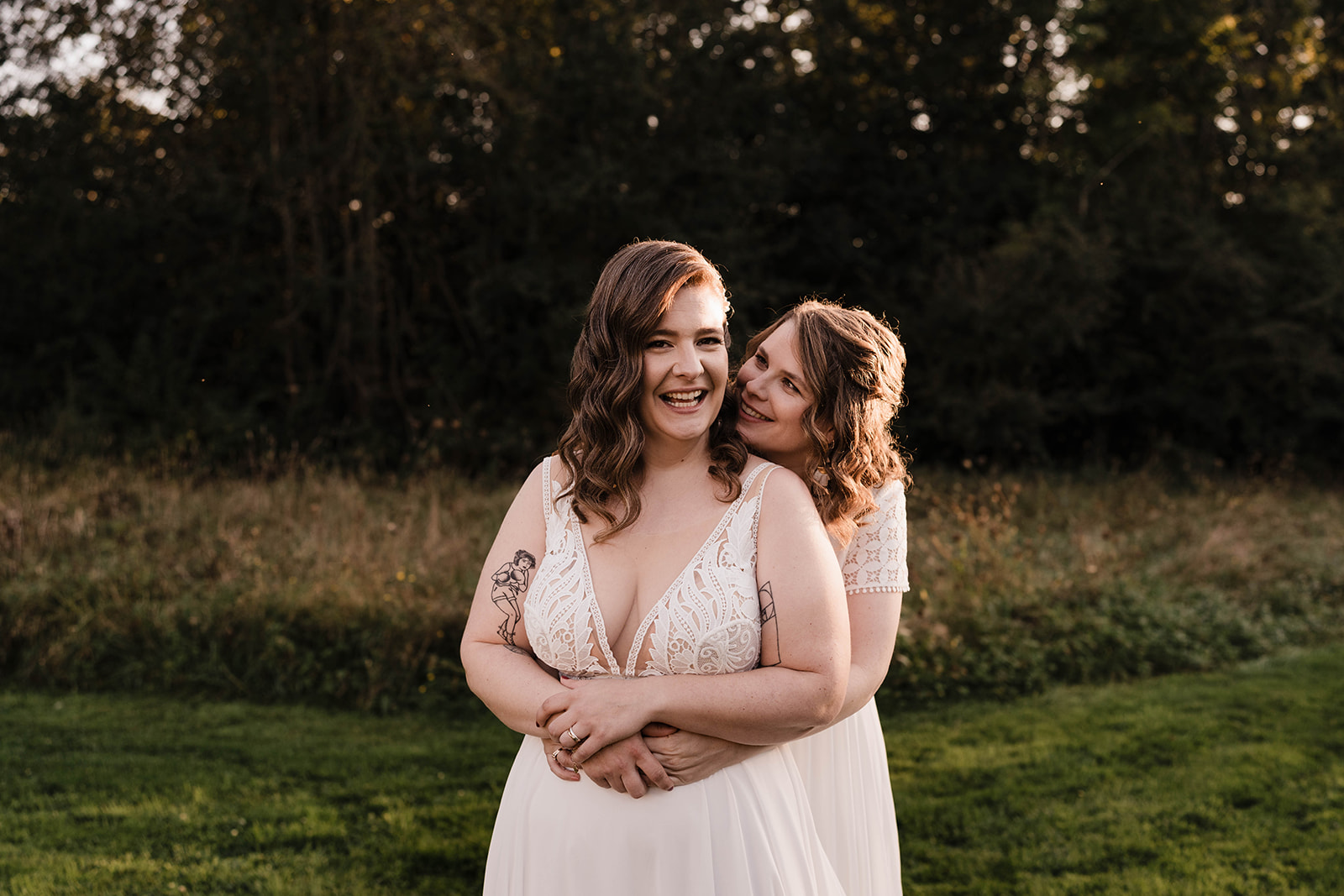
Is a queer photographer automatically better for a queer wedding?
No. Sharing an identity does not automatically make someone talented, respectful or right for you. Queer people are not issued flawless communication skills with the membership card — tragic administrative oversight.
A cisgender, heterosexual photographer can photograph LGBTQ+ weddings beautifully if they bring awareness, respect, experience and the willingness to listen. Equally, you should not book a queer photographer whose work or personality does not feel right simply because of shared identity.
But working with a queer photographer can remove a layer of translation. There may be less explaining and less uncertainty about whether your identities, community or family structures will be understood.
As a queer and non-binary person, I know how much energy it can take to assess whether a space is safe. That lived experience shapes the way I communicate, notice power dynamics, guide portraits and protect the atmosphere around my couples. It is part of my perspective, not my entire résumé.
You can read more about my experience and values on my About page.
What should queer wedding photography look like?
There is no queer visual formula. Queer love is not a preset.
Your photographs can be quiet, opulent, editorial, documentary, cinematic, funny, sensual, fashion-led or gloriously chaotic. They can include a château, a Paris mairie, two suits, no suits, a white dress, a red dress or an outfit category that refuses to be contained by this sentence.
The photographs should reflect the energy of your relationship and the celebration you actually created. Identity can be visible without becoming a visual gimmick. Elegance does not belong to heterosexual tradition, and queer joy does not have to be loud to be radical.
My work combines documentary observation with an editorial sensibility. I want the images to feel visually intentional without making the day feel like a production. There is room for beautiful light and composition, but never at the expense of the people inside the frame.
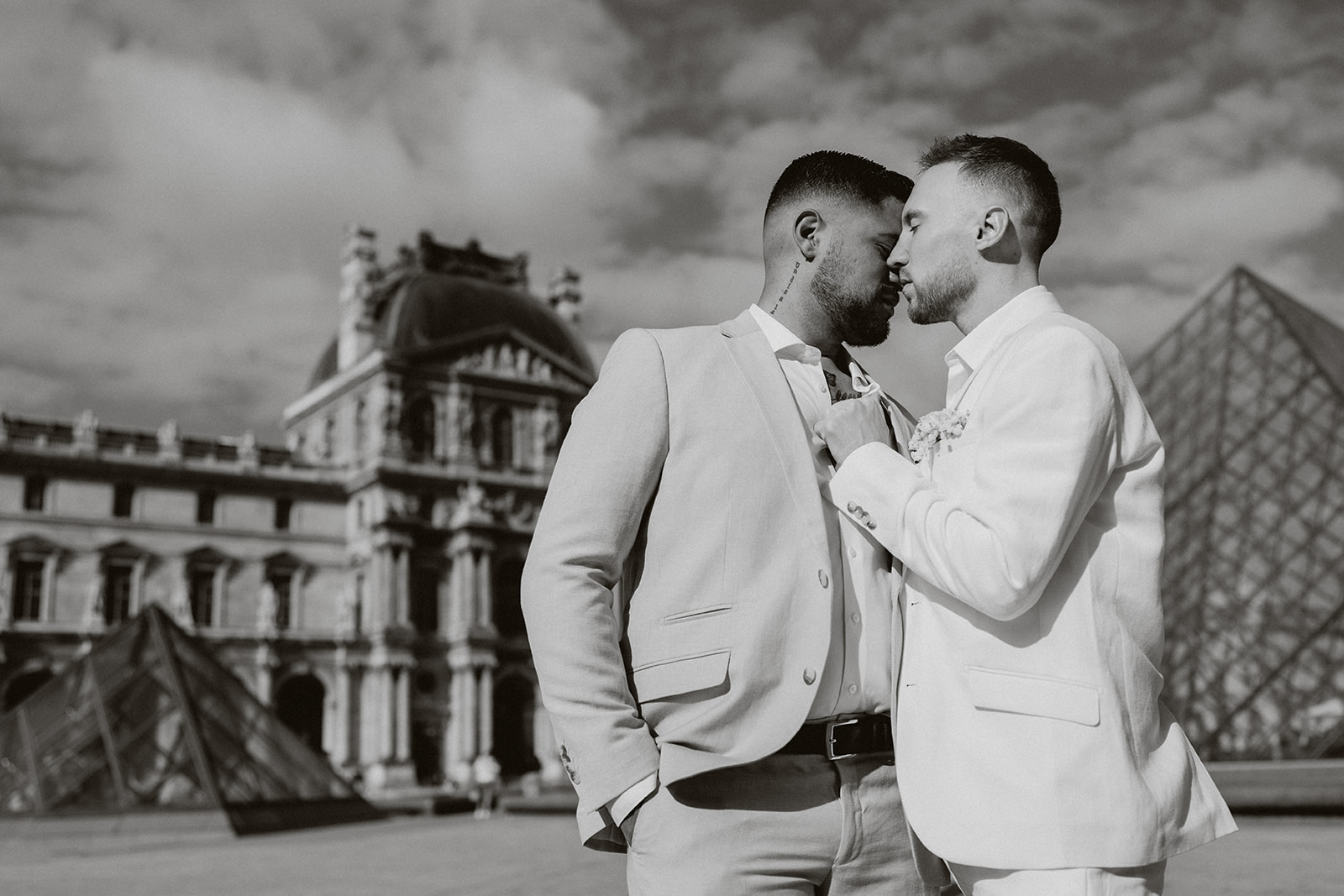
Planning a queer destination wedding in France
France can hold many versions of a queer wedding: a civil ceremony in Paris, dinner in a private salon, a château weekend, an elopement or a multi-day celebration bringing people from several countries together.
The right format depends less on what a French wedding is “supposed” to be and more on how you want to spend time with your people.
An intimate celebration in Paris
Paris works beautifully for couples who want a compact celebration with a strong sense of place: a mairie ceremony, portraits through the city and dinner with a small group, for example. You can also explore the Paris wedding venues I have photographed.
A château wedding in France
A château does not oblige you to reproduce aristocratic or gendered traditions. The joy can be precisely in reclaiming the setting: your words, your clothes, your families, your rules.
If that sounds like your kind of contradiction — centuries-old architecture, absolutely no compulsory bouquet toss — discover French château wedding venues through a photographer’s eyes.
A multicultural, multi-day wedding
When guests travel from different countries, a welcome dinner or next-day brunch gives relationships time to form beyond the formal schedule. It can also create more space for several languages, cultures and chosen traditions without compressing every meaningful thing into twelve hours.
My guide to planning a destination wedding in France as an international couple covers the experience more fully, while my destination wedding timeline and photography tips helps turn that experience into a workable rhythm.
If you are considering a legal marriage in France, confirm current requirements with the relevant mairie and an appropriately qualified professional. Your mood board, however excellent, is not legal advice.
Multicultural and queer weddings: let complexity remain
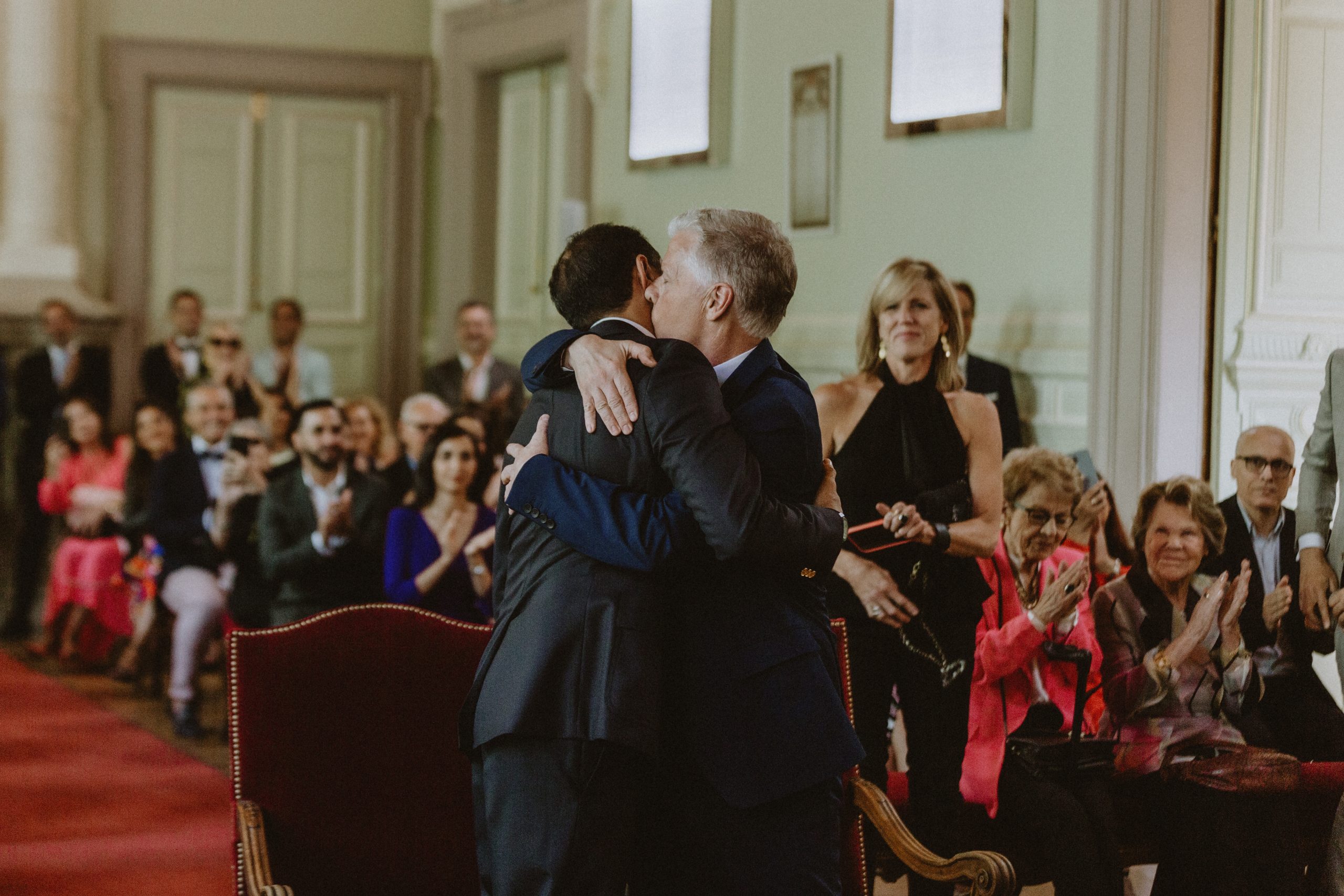
Many couples I photograph are queer and multicultural or international. Their weddings may bring together several languages, religions, migration stories, family expectations and definitions of marriage.
That complexity should not be flattened into “colourful traditions” for the camera. Nor should one culture become the interesting background to another. A photographer needs to understand what is happening, who is involved and why a gesture matters before deciding how to photograph it.
Before the wedding, I ask about the people and rituals that carry meaning. On the day, I watch the reactions around the central event as carefully as the event itself: the relative translating quietly, the friend who understands what a song means, the parent seeing a tradition changed and continued at once.
These are not decorative details. They are the story.
My approach to queer wedding photography in France
My process is called SOFT™: Safe, Open, Flow, True.
- Safe: your identities, boundaries and relationships are respected.
- Open: I begin without a rigid script and stay curious about what you have created.
- Flow: I guide when it helps, step back when the moment is already happening and adapt as the day changes.
- True: the photographs should feel like your relationship, not my idea of what a wedding couple should look like.
Before the wedding, I learn how you want the day to feel, who your people are, which words you use and where extra care may be needed. I also help shape a timeline that leaves enough room to live the wedding rather than constantly leave it for photographs.
On the day, I work with attention rather than interruption. I notice the large moments and the small evidence around them: hands finding each other before the ceremony, the friend checking in from across the room, an outfit adjustment, an uncontrollable laugh, the second before composure returns.
When direction is useful, it is simple and responsive. No stiff choreography. No “which one of you is the man?” energy. No transformation into generic wedding people.
The aim is a body of photographs that feels elegant, emotionally honest and unmistakably yours.
Explore my destination wedding photography in France to learn more about the experience and see my work.
Choose the gaze that lets you be yourselves
The right photographer does more than document what your wedding looked like. They influence how comfortable you feel while it is happening and what parts of the experience remain visible years later.
Choose someone whose work moves you, whose presence settles you and whose process gives you concrete reasons to trust them. Someone who can see your queerness without reducing you to it. Someone who understands that your wedding can be elegant, political, private, joyful, culturally layered, spectacularly dressed — or all of the above before dinner.
If you are planning a queer, LGBTQ+, non-binary or multicultural wedding in Paris, elsewhere in France or across Europe, I would love to hear what you are creating.
Frequently asked questions
What is a queer wedding photographer?
A queer wedding photographer is generally a photographer who belongs to the LGBTQ+ community. The phrase can also be used more broadly in searches for photographers who specialise in queer weddings. Identity alone is not a guarantee of compatibility; look at the photographer’s work, language, process and approach to consent.
Do you photograph LGBTQ+ and same-sex weddings in France?
Yes. I photograph queer, LGBTQ+, same-sex and non-traditional weddings in Paris, throughout France and across Europe. I also work with couples whose wedding brings together several cultures and languages.
Do you photograph non-binary and trans people respectfully?
Yes. I ask for the names, pronouns and language you want me and any member of my team to use. Portrait guidance is based on your comfort and natural dynamic, not on assigned gender roles.
Can our wedding photographs remain private?
Confidentiality and publication preferences should be discussed before signing the contract. If you need complete privacy or restrictions on particular people or moments, tell me during the inquiry process so that we can agree on clear terms.
Do we need to be comfortable in front of the camera?
Not at all. Most of my couples are not used to being photographed. I use simple prompts and movement when guidance helps, then step back when connection happens naturally. You will not be expected to arrive knowing what to do with your hands. A historic queer victory for us all.
Where can we plan a queer destination wedding in France?
Paris, Provence, the French Riviera, Bordeaux, Normandy, the Loire Valley and the countryside can all work beautifully. Start with the experience you want, then assess accessibility, privacy, accommodation, legal requirements and whether the venue team makes you feel genuinely welcome.
How early should we book a wedding photographer in France?
For popular weekend dates and destination weddings, many couples inquire 12 to 18 months ahead. Shorter notice may be possible for weekday civil weddings, elopements and off-season celebrations. Availability varies, so it is always worth asking.