


An elopement in Paris does not have to involve saying your vows beneath the Eiffel Tower while a violinist appears from nowhere.
Unless that is genuinely your thing. In which case, I respect the commitment.
For many of the international and LGBTQ+ couples I work with, choosing to elope is less about running away and more about removing the parts of a traditional wedding that do not feel right. You might want to exchange private vows, get dressed beautifully, walk through the city, have an excellent dinner and spend the day with the person you are marrying rather than following a schedule built around everybody else.
Paris gives you many ways to do that. The right setting, however, depends on what you mean by “elopement.”
Are you planning a legal civil ceremony? A symbolic exchange of vows? A day for the two of you, or a small celebration with a few guests? Do you want privacy, architecture, movement through the city or somewhere everyone can sit down and stay for a while?
As a Paris elopement photographer, I help couples turn those questions into a day that feels coherent, relaxed and personal—and into photographs that look like their experience rather than a checklist of Paris landmarks.
First: what does eloping in Paris actually mean?
Today, an elopement does not necessarily mean disappearing in secret and informing your families afterwards.
It can be:
-
A legal civil ceremony followed by photographs and dinner
-
A symbolic ceremony for just the two of you
-
An intimate wedding with a small number of guests
-
A private exchange of vows during a trip to Paris
-
A multi-part celebration, with the legal marriage completed in your home country
-
A civil ceremony on one day and a more personal celebration on another
There is no official number of guests that suddenly turns an elopement into a wedding. The difference is usually found in the intention and the scale: fewer expectations, fewer moving parts and more freedom to shape the day around your relationship.
That freedom is valuable—but an elopement still benefits from a little structure. Two people can absolutely require a timeline, especially when hair and makeup, flowers, transport, a ceremony, several locations and dinner reservations are involved.
Small does not automatically mean simple. It does mean we can make every part of the experience more deliberate.

Can international couples legally marry in Paris?
This is the first question to answer because a legal marriage and a symbolic elopement are not the same thing in France.
French civil marriages are performed at a mairie, or town hall. In most situations, at least one member of the couple—or one of their parents—must have a qualifying connection through domicile or residence to the municipality where the marriage will take place.
Booking a hotel in Paris for a few nights does not usually create that connection.
There are specific exceptions, including provisions that may apply to same-sex couples living in a country where their marriage is not permitted. Your nationality, residence and personal circumstances can all affect the process, so you should confirm the current requirements directly with the relevant mairie or an appropriately qualified professional.
You can consult the official French government information about marriage in France, but do not rely on a photographer—or a very confident wedding blog—to provide legal advice.
For many international couples, the most straightforward option is to complete the legal marriage in their home country and organise a symbolic ceremony in Paris.
That does not make the Paris celebration less meaningful. It simply separates the administrative part from the experience you want to remember.
Start with the experience, not the landmark
When couples ask where they should elope in Paris, my first question is not “Which monument do you prefer?”
I want to know how you imagine the day feeling.
Do you want to get ready slowly in the same place? Exchange vows somewhere private? Walk through the city without a large production following you? Invite six people to dinner? Change outfits? Have a ceremony that your families can watch remotely?
A location can look impressive online and still be completely wrong for the experience you want.
Before choosing where to elope, consider:
- The level of privacy you need
- Whether you will have guests
- Whether the ceremony is legal or symbolic
- How far you are comfortable walking
- The time of year and sunrise time
- Where you will get ready
- Whether you need somewhere to change
- How much travelling you want to do
- Accessibility for you and your guests
- Whether professional photography or a ceremony requires permission
- Where you would like to finish the day
The best location is not necessarily the most recognisable one. It is the place that allows you to be present without creating unnecessary complications.

A private suite or apartment for an intimate ceremony
A hotel suite or private apartment can be one of the most comfortable choices for a symbolic elopement.
You can get ready without travelling across the city in formal clothes, exchange vows somewhere protected from crowds and weather, open a bottle of champagne and leave for portraits when you are ready.
This format works especially well if privacy matters to you or if you want the ceremony itself to feel quiet. It can also make it easier to include a handful of guests, a celebrant or relatives joining by video.
From a photography perspective, not every beautiful room works equally well. Before booking, look beyond the bed and the marble bathroom.
Consider:
- The direction and quality of the window light
- Whether the room is large enough for two people and your suppliers
- The visual clutter around the room
- Whether photography is permitted
- Whether the hotel allows external professionals
- Where you could exchange vows without moving all the furniture
- Whether there is another room or salon available if guests are attending
Paris has extraordinary hotels, but the most expensive suite is not automatically the most useful one. Light, space and permission matter more than the number of cushions on the bed.
For examples of hotels and private reception spaces I know through photography, you can explore my guide to Paris wedding venues, hotels and private clubs.
A civil ceremony followed by a walk through Paris
If you are eligible to marry legally in Paris, a mairie ceremony can become the centre of an intimate and beautifully paced day.
The ceremony itself is often short. What gives the story depth is everything around it: getting ready separately or together, arriving at the mairie, waiting outside, greeting the people who came, the reactions during the ceremony and the release of tension once you step back onto the street.
Afterwards, we can continue with photographs nearby, stop for lunch or drinks, or build a longer route through the city.
The important thing is not to plan the entire day around the mairie’s façade. Each Paris town hall has its own interior, surroundings and practical constraints. The neighbourhood around it can be just as relevant as the ceremony room.
My guide to the most beautiful Paris town halls for a wedding can help you compare different settings. If your plans are centred on a civil ceremony, you can also discover my approach as a civil wedding photographer in Paris.
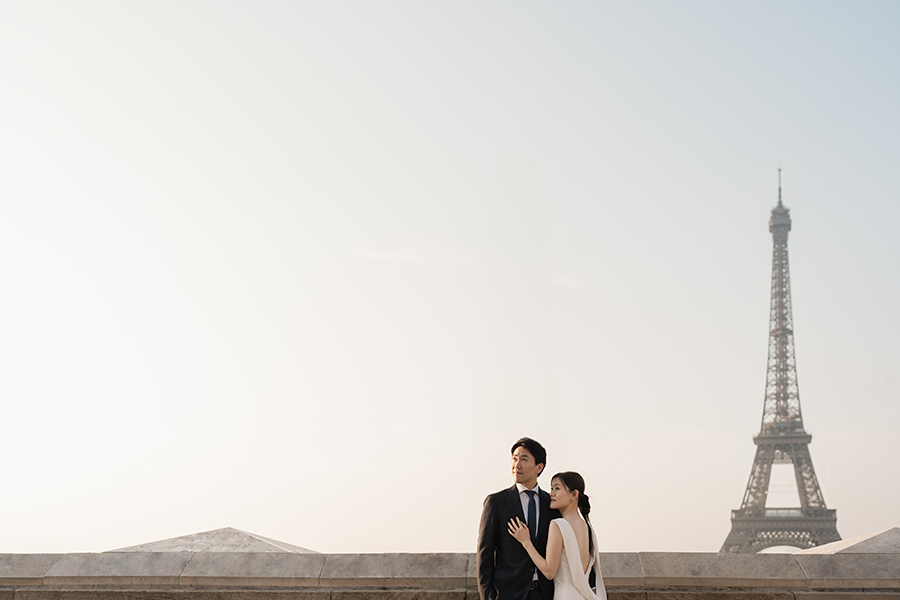
A symbolic ceremony outdoors
An outdoor ceremony can be very moving, but it is important to be realistic about privacy.
Paris is a working city, not a controlled wedding set. People commute, run, walk dogs, deliver furniture and occasionally position themselves in exactly the place where the light was perfect three seconds earlier.
If you exchange vows in a public space, you may not have silence or complete seclusion. This does not make an outdoor ceremony impossible. It simply means choosing the time and place carefully—and accepting that the city will remain alive around you.
A quiet riverside setting early in the morning can work beautifully for two people. A garden may suit a short exchange of vows, but opening hours, visitor numbers and photography rules need to be checked. A small square or less exposed street can feel more personal than standing in the centre of a major viewpoint.
Depending on the location, number of guests, equipment and type of setup, permission may be required. I recommend checking this before making firm plans, particularly if you want chairs, floral arrangements, an officiant or anything that begins to resemble an organised event.
The aim is to find a space that supports the ceremony—not to spend your vows wondering whether a tour group is about to walk between you.
Paris architecture without turning the day into a location tour
You may want photographs that unmistakably belong to Paris. That does not mean visiting every recognisable location in one afternoon.
For more editorial portraits, architectural settings with clean lines, stone façades, colonnades or formal gardens can create structure without overpowering you. A carefully chosen route may give us several visual environments within walking distance: formal architecture, a quieter street and a more open view.
This usually produces a stronger story than crossing the city repeatedly for unrelated landmarks.
When choosing portrait locations, I consider:
- The direction of light at that time
- How busy the area is likely to be
- The distance from your ceremony or hotel
- Your clothes and shoes
- How much privacy you need
- Whether your outfits suit a formal or more relaxed environment
- The variety we can create without unnecessary travel
Paris should provide the setting, but it should not become the main character in every photograph.
Your gallery still needs pauses, close portraits, movement, gestures and the moments when you briefly forget about the camera. Otherwise, you end up with twelve photographs proving that you visited Paris and very few showing what the day felt like.
If being photographed makes either of you nervous, my guide to having a couple photoshoot in Paris without knowing how to pose explains how I work.
An elopement built around dinner
Not every ceremony needs to be the visual centre of the day.
You may prefer to exchange vows privately and bring a few people together for dinner afterwards. A private dining room, hotel salon or restaurant space can create a natural transition from ceremony to celebration without turning your elopement into a reduced version of a large wedding.
This format is particularly good for couples who want intimacy without excluding everyone important to them.
You could:
- Get ready together
- Exchange vows privately
- Take portraits around Paris
- Meet your guests for cocktails
- Have dinner in a private room
- Include a few speeches or personal rituals
- Finish with evening photographs outside
With a small group, dinner becomes part of the story rather than simply the meal that happens after the photographs. I can document the conversations, reactions, speeches and quieter interactions without needing to interrupt the evening constantly.
When choosing a restaurant or private room, check whether photography is allowed and whether the space has enough light. Candlelight may feel wonderful in person while leaving everyone almost invisible to a camera. I can work with difficult lighting, but it is useful to know what we are walking into.

What does an LGBTQ+ elopement in Paris need?
The practical structure of a queer elopement is not fundamentally different from any other elopement. You need a place, a plan, people you trust and suppliers who understand what you are creating.
The difference is that LGBTQ+ couples may have additional questions they should not have to ignore:
- Will the venue and its staff welcome us naturally?
- Will the celebrant use the right language?
- Will suppliers avoid assigning traditional gender roles?
- Can our photographs remain private if needed?
- Will our chosen family be treated as family?
- Can we adapt or discard traditions that do not belong to us?
- Will we need to explain ourselves all day?
An inclusive supplier should be able to answer these questions through their actual process, not only through a rainbow badge on their website.
As a queer and non-binary photographer, I do not decide which one of you should lead, hold, propose or appear more masculine or feminine. I begin with the way you already relate to each other.
You can wear two suits, two dresses, neither or something that makes those categories feel rather limited. You can get ready together or separately. You can walk into the ceremony side by side. You can include your families, your chosen family, both or nobody at all.
Tradition is available to you. It is not assigned to you.
My guide to choosing a queer wedding photographer in France explains the practical signs of genuinely inclusive photography in more detail.
How long should a Paris elopement last?
There is no standard duration, because an elopement can range from a portrait session with private vows to a complete wedding day.
Two to three hours
This may be enough for:
- A private exchange of vows
- One main area of Paris
- Couple portraits
- A few photographs before or after the ceremony
This format works best when everything happens close together and you have one outfit.
Four to six hours
This allows more room for:
- Part of the preparations
- A ceremony
- Several nearby photographic settings
- A change of atmosphere
- Champagne, lunch or the beginning of dinner
- A small number of guests
Eight hours or more
A longer elopement can include:
- Both preparations
- A first look
- A civil or symbolic ceremony
- Family and group photographs
- Couple portraits
- Travel between locations
- Dinner and speeches
- Daylight and evening photographs
You do not need to fill every minute with activities. Some of the most useful time in an elopement timeline is deliberately empty. It lets you eat, breathe, fix your hair, change plans or spend twenty minutes doing absolutely nothing productive with the person you just married.
That is not wasted time. That is the day.
A realistic Paris elopement timeline
Here is an example of a relaxed six-hour elopement:
2:00 pm — Preparations
Details, clothes, final touches and the quieter moments before leaving.
3:15 pm — First look and private vows
A private exchange at your hotel or accommodation.
3:45 pm — Portraits nearby
We begin close to the ceremony setting rather than immediately getting into a car.
5:00 pm — Travel and second photographic setting
A change of architecture or atmosphere, chosen according to the light.
6:15 pm — Drinks with your guests
Time to reconnect, stop posing and let the day become social.
7:00 pm — Dinner
Photographs of the table, conversations and the beginning of the evening.
This is only an example. Sunrise sessions, winter elopements, civil ceremonies and celebrations with guests all require different rhythms.
A good timeline should give the day shape without making you feel supervised by a spreadsheet.
How I photograph an elopement in Paris
My approach combines documentary observation with editorial composition.
I will help you plan a route that makes sense, identify the right light and guide you when direction is useful. I will also step back when the moment already has everything it needs.
You will not spend the day reproducing a collection of poses.
There may be a deliberately composed portrait using the architecture, followed by a photograph of one of you trying to prevent a veil from entering traffic. Both belong in the gallery. A polished image and an imperfect moment are not opposites. Together, they make the story feel complete.
My process is called SOFT™:
- Safe: your identities, boundaries and relationships are respected.
- Open: I remain curious about the celebration you are creating.
- Flow: I guide when it helps and adapt when the day changes.
- True: your photographs should reflect your relationship, not a template.
Before the elopement, we discuss what matters to you, how you feel about being photographed, who will be present and any family, privacy or accessibility considerations I should understand.
On the day itself, you should not have to manage the photography. You have better things to do—possibly involving vows, champagne or both.
Frequently asked questions
Is an elopement in Paris legally binding?
Only a valid civil marriage performed by the appropriate French authority is legally binding in France. A symbolic ceremony or private exchange of vows is not a legal marriage. International couples should verify their eligibility and required documents directly with the relevant mairie or a qualified legal professional.
Can we elope in Paris if we do not live in France?
Yes, you can organise a symbolic ceremony and elopement experience in Paris regardless of where you live. Eligibility for a legal civil marriage is a separate matter and depends on your circumstances.
Is same-sex marriage legal in France?
Yes. However, international couples still need to check the administrative requirements that apply to their nationality and country of residence.
Can our elopement photographs remain private?
Yes, but privacy expectations should be discussed before signing the contract. Some couples are not publicly out, have sensitive professions or simply do not want their celebration shared online. Tell me what you need so that the publication terms are clear from the beginning.
Do we need witnesses for a symbolic ceremony?
No legal witnesses are required for a symbolic ceremony. You may invite friends, family members or a celebrant, but you can also exchange vows with only your photographer present.
Can you help us choose the locations?
Yes. I recommend locations according to your ceremony, accommodation, clothes, preferred atmosphere, mobility, privacy needs, season and available time.
What happens if it rains?
We prepare for that possibility rather than behaving as though Paris has signed a contract guaranteeing sunshine. Depending on the conditions, we can adapt the route, use covered settings, work with the rain or adjust the schedule when possible.
Can we invite a few guests?
Of course. An elopement can include the people who genuinely matter to you. A small ceremony followed by dinner often creates a good balance between privacy and connection.
Can you recommend other suppliers?
I can help you build a trusted team according to your needs, including wedding planners, celebrants, hair and makeup artists, florists and other professionals accustomed to international or LGBTQ+ couples.

Plan an elopement that belongs to you
The point of eloping is not to perform a smaller version of somebody else’s wedding.
It is to decide what deserves space.
Perhaps that is a civil ceremony and lunch with ten people. Perhaps it is getting dressed together, exchanging vows privately and spending the afternoon walking through Paris. Perhaps it is a hotel suite, an excellent dinner and no traditions beyond the ones you chose yourselves.
Once we understand that, choosing where to elope becomes much easier.
If you are organising the experience from abroad, my guide to planning a destination wedding in France as an international couple will help you anticipate some of the practical details.
And if you are looking for an inclusive Paris elopement photographer who will help you shape the photographic experience without turning your day into a production, tell me what you are planning.
Tell me where you are travelling from, who will be joining you and what you would like the day to feel like. We can begin with that.